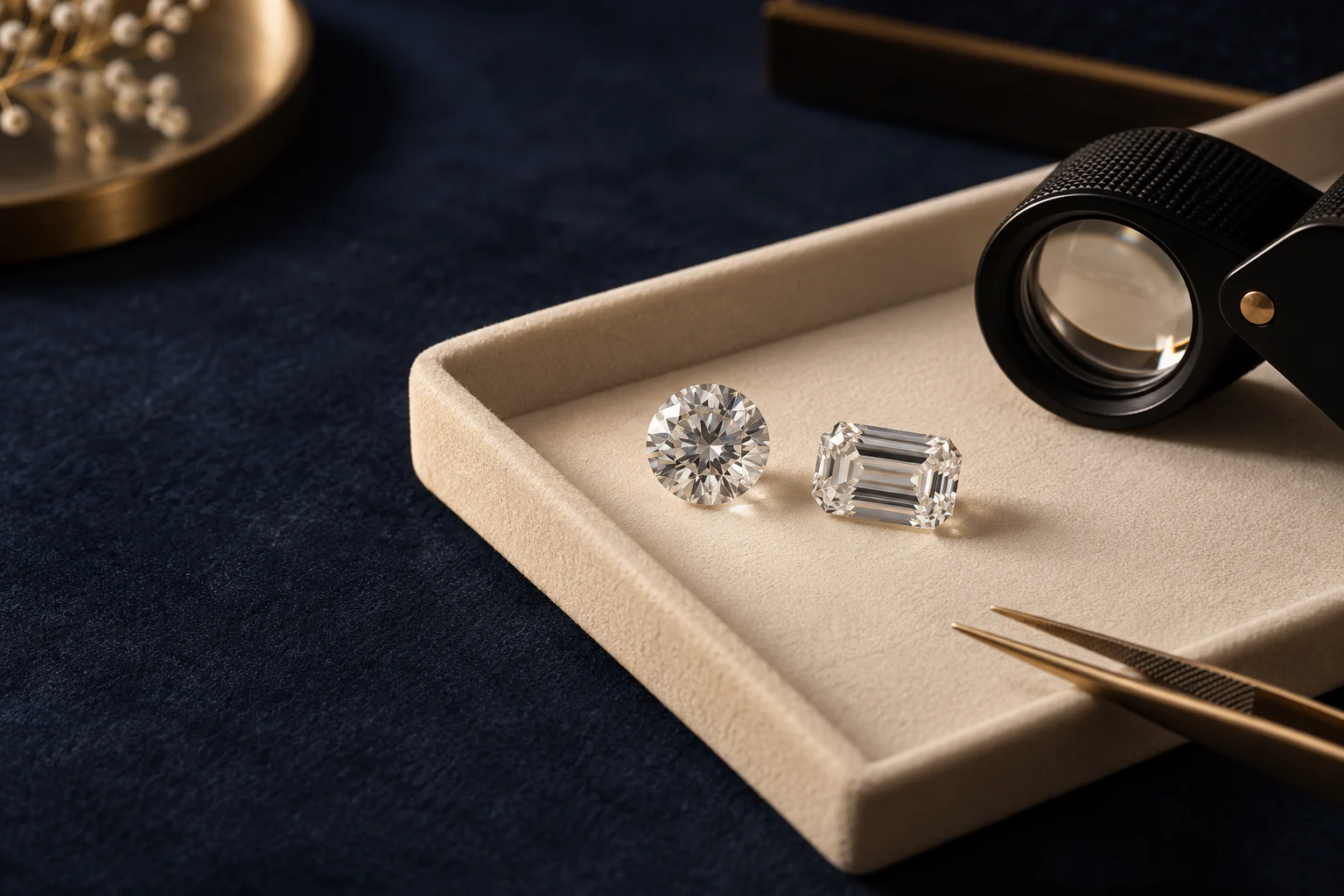
Every diamond is described by the same four words: cut, colour, clarity and carat. They are useful, and they are also where most of the confusion starts. Here is what each one means when the stone is in front of you rather than on a certificate — and the order we would spend in.
Cut: how the stone returns light
Cut is not the shape. A round, an oval and a pear can each be cut well or badly. Cut describes how precisely the facets are angled and finished, and so how much of the light that enters the stone comes back out of the top.
It is the one grade you can see from across a room. A well-cut diamond looks bright and lively; a poorly cut one can look glassy or dark in the centre, whatever its other grades say. If you take one thing from this page, let it be this: spend on cut first.

Colour: how close to colourless
Colour is graded on a letter scale. D, E and F are colourless and read white in any setting. G to J are near-colourless — the warmth is faint, and set in yellow or rose gold it often disappears entirely, because the metal around the stone colours what you see.
So the right colour grade depends on the metal. In white gold or platinum, a higher grade is easier to notice. In yellow or rose gold, a stone in the G–J range can look identical to one several grades higher. Take colour to the point where it reads white in your metal, and stop there.
Clarity: what is inside
Almost every diamond holds tiny marks from the way it formed — crystals, feathers, the occasional cloud. Clarity grades how many there are, how large, and where they sit.
The useful question is not “how flawless is it?” but “can I see anything without a loupe?” Once nothing is visible to the eye at a normal distance, a stone is eye-clean, and more clarity beyond that point costs money nobody can see. Stop clarity at eye-clean.
Carat: weight, not size
Carat measures weight. Two stones of the same weight can look quite different on the hand: shape decides how much surface faces up, and cut decides how the weight is spread. A well-cut stone can look larger than a heavier one that carries its weight deep, where nobody sees it.
That is why carat comes last. Once cut, colour and clarity are where they should be, buy as much carat as is left.
How we would spend it
- Cut first. It is the grade people actually see.
- Colour to white in your metal. Higher for white gold and platinum, lower for yellow and rose.
- Clarity to eye-clean. Anything beyond is invisible.
- Carat with what remains.
The grades are not ours to give
The centre diamonds of our engagement rings are graded by IGI or GIA, never by us, and where a piece comes with a certificate it arrives with it. The certificate is the stone’s own record — keep it with the piece, and keep it safe.
For the short version to keep on your phone, see The 4Cs. If you would like a second opinion on a particular stone, write to us — a person answers.